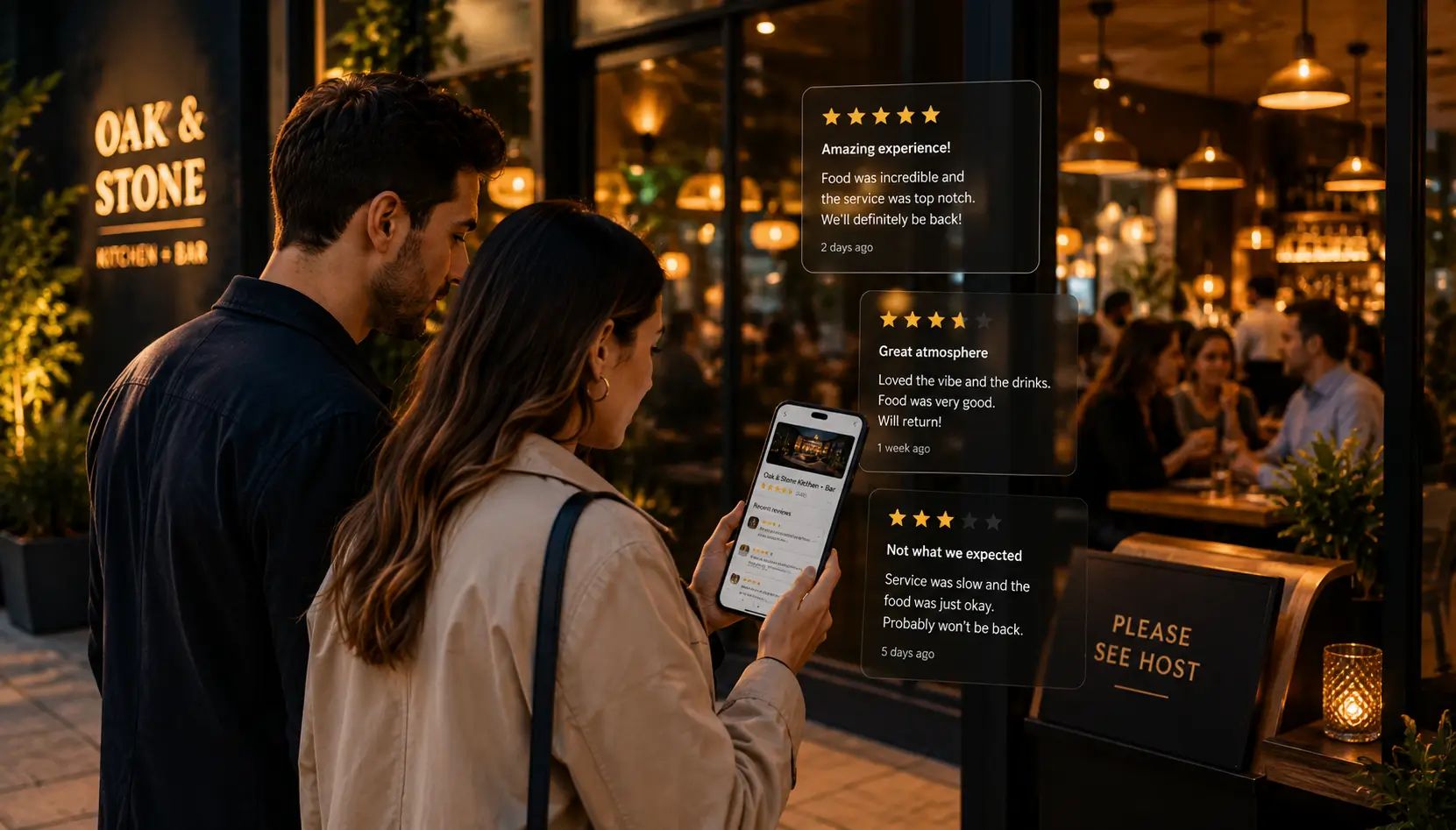
The reality many restaurant owners do not want to admit
A lot of restaurant operators still think reviews are something that happens after service. Technically, that is true. The guest leaves, opens their phone, and writes what happened.
But from the next guest’s point of view, that review is not after the service. It is before the decision.
The next guest may be standing outside, sitting in a hotel room, or riding in the passenger seat while someone asks, “Where should we eat?” Then the phone comes out. They check the rating. They skim the recent comments. They look at photos. They search for patterns.
If the most recent reviews mention cold food, slow service, dirty bathrooms, rude staff, or managers who never responded, that guest may never walk in.
The public review is not just feedback. It becomes a decision tool for the next guest.
Why diners have become so careful
Eating out is not cheap. A disappointing meal is not just the cost of the food. It is the drive, the wait, the tip, the mood, the people at the table, and the night that did not go the way they hoped.
That is why modern diners use reviews like risk protection. They are trying to answer a simple question before they spend their money: “Is this place worth it tonight?”
This matters even more in tourism-heavy markets, where guests may only have one chance to choose dinner during a trip. They do not know the local operators personally. They trust what recent guests say.
Operator insight
Recent reviews can matter more than old reputation.
A restaurant may have a strong brand, great food, and years of goodwill. But if the recent comments suggest service is slipping, guests may treat that as the current truth.
What diners are really looking for
The star rating matters, but guests are not only looking at the average. They are scanning for signs.
- Are recent guests saying the service was slow?
- Do the food photos look fresh and appetizing?
- Are complaints repeated or isolated?
- Does management respond professionally?
- Do people mention cleanliness, attitude, or wait times?
A single negative review may not scare everyone away. A pattern will. Guests can forgive a one-off mistake. They are much less forgiving when five different people mention the same problem.
That is where restaurants need to pay attention. The issue is not just whether someone complained. The issue is whether the same kind of complaint keeps appearing after the guest has already left.
The hard truth for restaurants
Every guest who reads your reviews and chooses another restaurant is invisible lost demand. They do not call to tell you. They do not fill out a form. They do not ask for the manager. They simply go somewhere else.
That means a bad experience can cost more than the one table that had the problem. It can affect future guests who never gave you the chance to win them over.
Most public reviews are late signals.
By the time the review appears, the guest is usually gone, the manager missed the recovery window, and the restaurant is stuck reacting in public instead of fixing the experience in private.
The painful part is that many of these issues could have been handled if the restaurant had known sooner. Cold food can be remade. A long wait can be explained. A missed drink can be fixed. A frustrated guest can sometimes be turned around by a manager who shows up at the right time.
But only if the signal reaches the restaurant while the guest is still reachable.
What restaurants can actually do about it
Restaurants cannot control what every guest thinks. They can control whether guests have an easy, private way to speak up before the experience becomes a public review.
A simple QR prompt at the table, on a card, at the host stand, or on a receipt can give guests a quieter way to say, “Something is off.” That is especially useful for guests who do not want to complain to a server or make a scene.
The goal is not to pressure guests or hide problems. The goal is to make hospitality faster. If a guest is disappointed, the restaurant should know while there is still time to recover the visit.
Hospitality has to move earlier
Modern diners are not wrong for checking reviews. They are trying to make a good decision with the information available to them.
The restaurant’s job is to make sure tomorrow’s guest does not learn about today’s problem from a public review that could have been prevented, softened, or fixed in the moment.
That is the shift: stop treating reviews as the first warning. Treat them as the last warning. The earlier signal is the one that matters.
FAQs
Frequently asked questions
Why do diners check reviews before choosing a restaurant?
Guests check reviews to reduce the risk of choosing a restaurant with poor service, inconsistent food, cleanliness problems, long waits, or other experience issues.
Are star ratings the only thing that matters?
No. Star ratings matter, but many guests also read recent comments, look at photos, and search for repeated complaint patterns.
Can restaurants stop every bad review?
No. But restaurants can create earlier private feedback channels so managers have a better chance to recover guest issues before they become public.
How does live guest recovery help?
Live guest recovery gives guests a private way to share concerns during the visit and gives managers a chance to respond while the recovery window is still open.