Tourism creates real operating pressure.
Destination restaurants need tools that work when tables are turning, guests are impatient, and managers are already stretched.
GuestRecovery Pilot Program
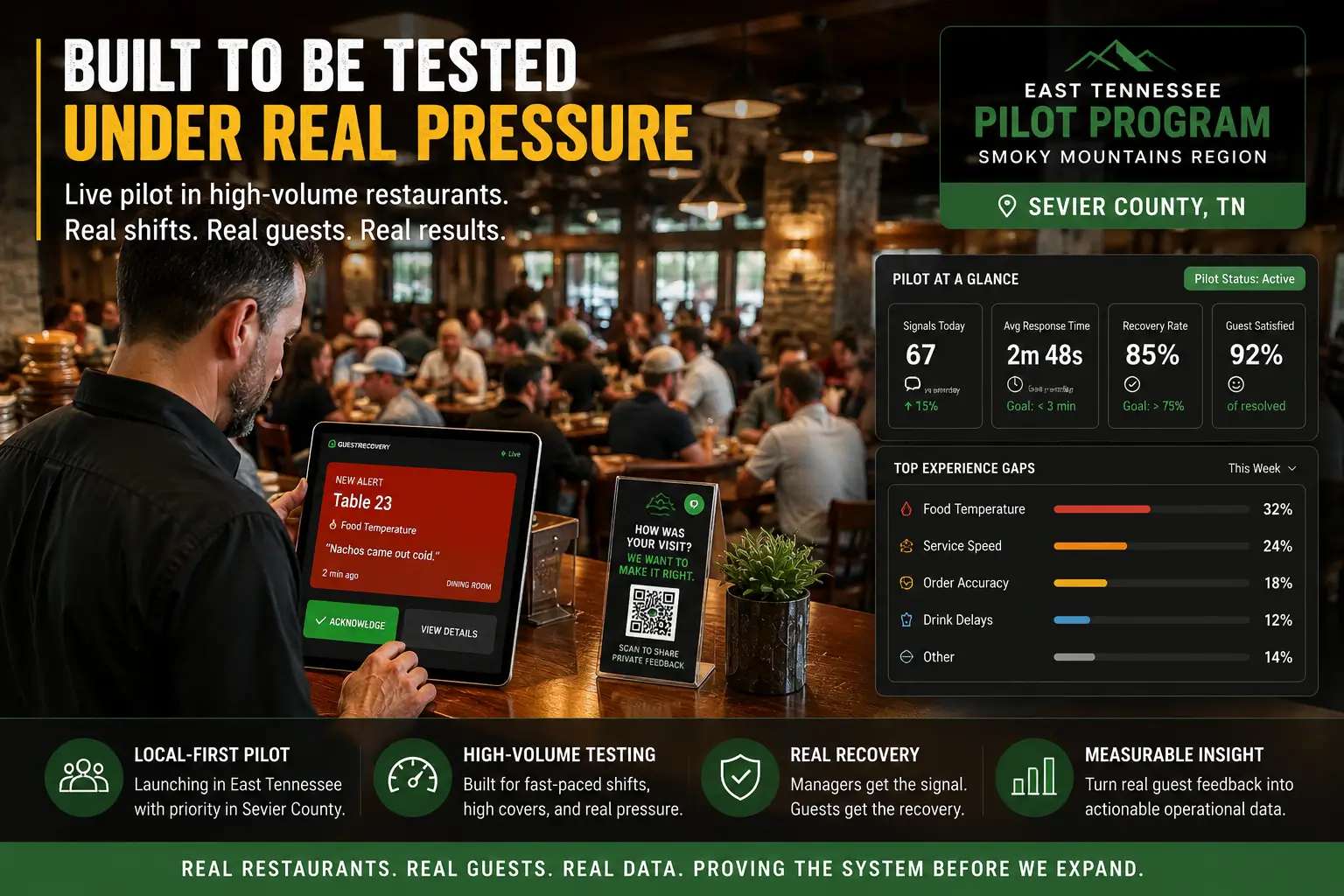
GuestRecovery is opening controlled pilot access first in the Smoky Mountains and East Tennessee region because easy markets do not prove hospitality software. This region gives restaurants real pressure: tourism surges, fast turns, high guest expectations, seasonal staffing, and constant review exposure.
Why this region first?
East Tennessee, Sevier County, Sevierville, Pigeon Forge, Gatlinburg, and the surrounding Smoky Mountains market are not quiet test environments. They are high-volume hospitality markets where restaurants deal with families, tourists, long waits, unpredictable rushes, staffing pressure, and guests who often choose where to eat based on public reviews.
Destination restaurants need tools that work when tables are turning, guests are impatient, and managers are already stretched.
In a tourism market, a guest's review can affect families and groups who have never visited the restaurant before.
The best time to fix an experience is while the guest may still be there, not after the story has already gone public.
Intentional rollout
The pilot is not about proving whether restaurants need better guest insight. They do. The pilot is about seeing which GuestRecovery workflows create the most value under real operating pressure: QR placement, manager alert timing, escalation rules, recovery tracking, staff praise, source tracking, and Experience Gap reporting.
Who the pilot is for
GuestRecovery is strongest where volume, reputation, staff consistency, manager response, and guest expectations all collide. That is why the first rollout is focused on restaurants that have something meaningful to gain from earlier private feedback.
Restaurants with enough guest flow to reveal patterns quickly and give managers meaningful recovery opportunities.
Places where public reviews, family travel decisions, and visitor expectations can directly affect future business.
Operations where owners and GMs need better visibility across managers, servers, sections, and shifts.
Teams that want real guest signals to support coaching, praise, standards, and operational improvement.
What gets deployed
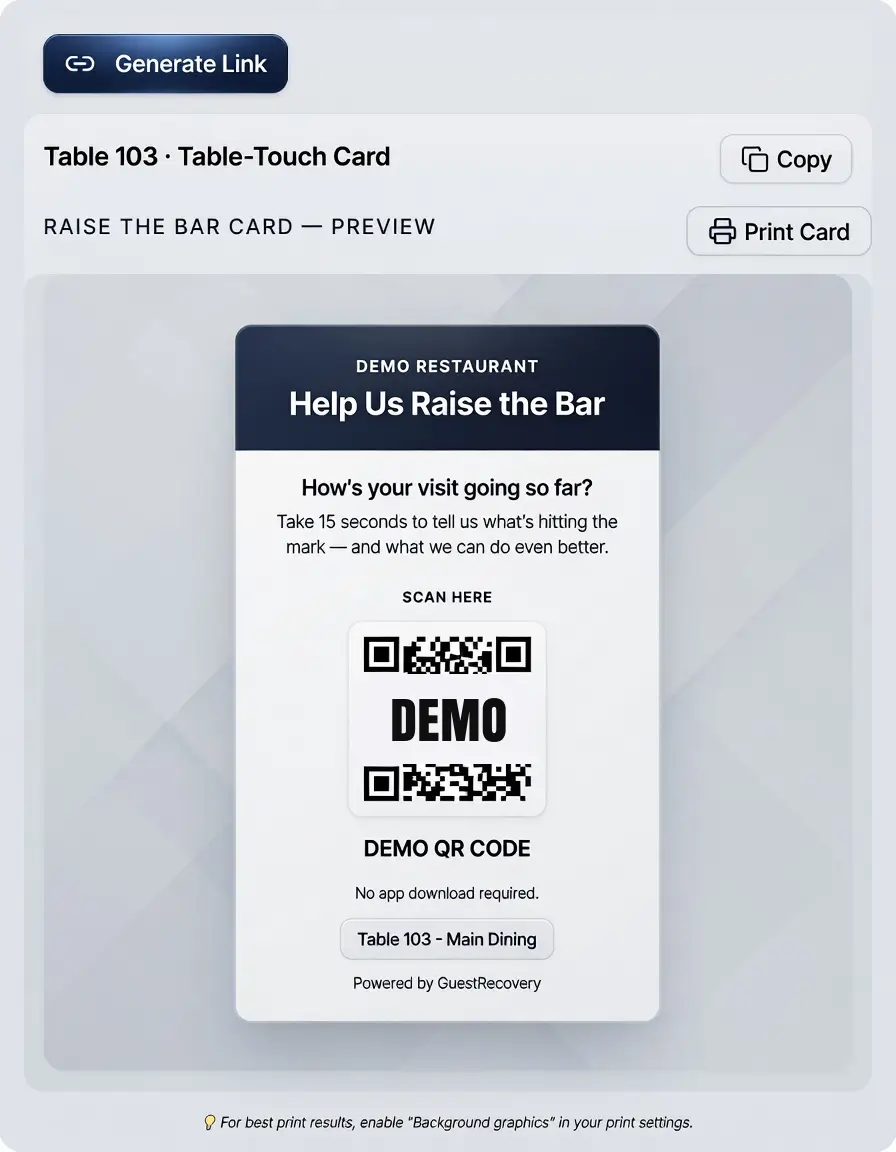
The pilot focuses on the core GuestRecovery workflow: guests get a private Raise the Bar invitation, managers get visibility when action is needed, and owners get clearer insight into what is happening across the guest experience.
What the pilot measures
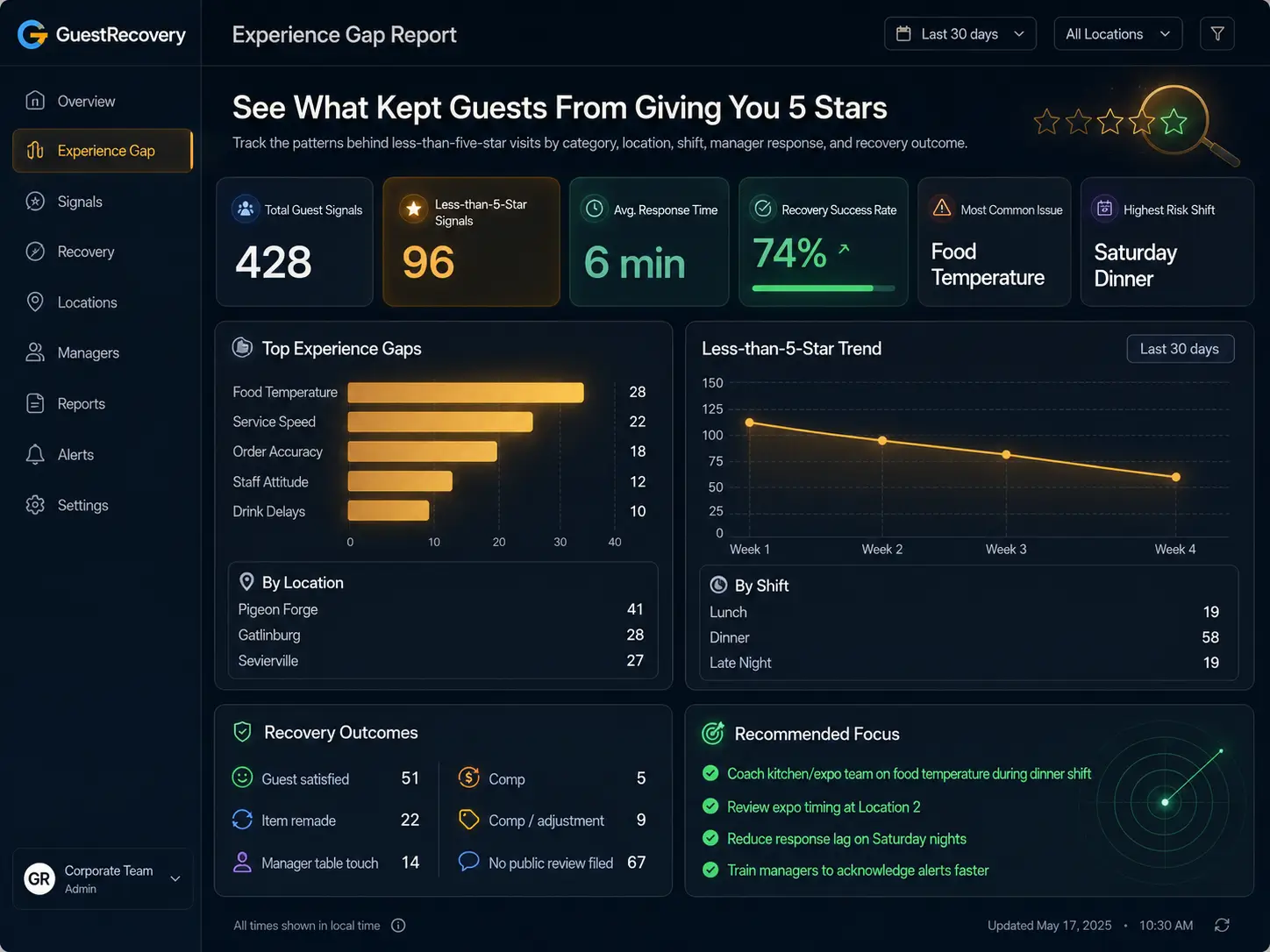
A useful pilot should show whether GuestRecovery is helping the restaurant hear guests earlier, respond faster, recognize what works, and identify what keeps guests from having a five-star experience.
Praise, suggestions, menu ideas, service feedback, and at-risk moments are captured before they disappear.
Acknowledgement and recovery timing help show whether at-risk guest signals are being handled quickly.
Recovery notes and outcomes turn one guest moment into accountability and training material.
Recurring categories show where the restaurant can coach, improve, staff, adjust, or recognize.
Feature growth
The foundation is live recovery. The growth path is deeper hospitality intelligence. Pilot feedback helps prioritize practical features that matter in real restaurants, not features imagined in a vacuum.
What success looks like
The win is not just a few scanned QR codes. The win is earlier feedback, faster response, better staff recognition, and clearer owner visibility into where the restaurant is winning or losing the guest experience.
Guests share useful insight they may not have said directly to a server or manager.
Less-than-4-star moments become visible while the team may still have time to recover the experience.
Managers can coach from real guest signals, recovery notes, praise, and recurring patterns.
Owners get a better sense of what guests love, what guests notice, and what needs to improve.
Local-first rollout
GuestRecovery is beginning with East Tennessee and the Smoky Mountains because this region has the right mix of hospitality pressure, tourism demand, public review influence, and operator urgency. The goal is to build the system under real conditions, refine what matters, and expand with a stronger product.
FAQs
Pilot access is opening first in the Smoky Mountains and East Tennessee region. Broader restaurant access can expand after the initial rollout.
High-volume hospitality pressure reveals what actually works. Tourism, review exposure, rushes, and staffing realities help shape a stronger product.
The pilot focuses on QR prompts, private guest feedback, manager alerts, recovery tracking, source tracking, praise capture, and Experience Gap reporting.
No. GuestRecovery uses controlled private walkthroughs and pilot access, not open public dashboards or unsecured demo environments.